
Job Description
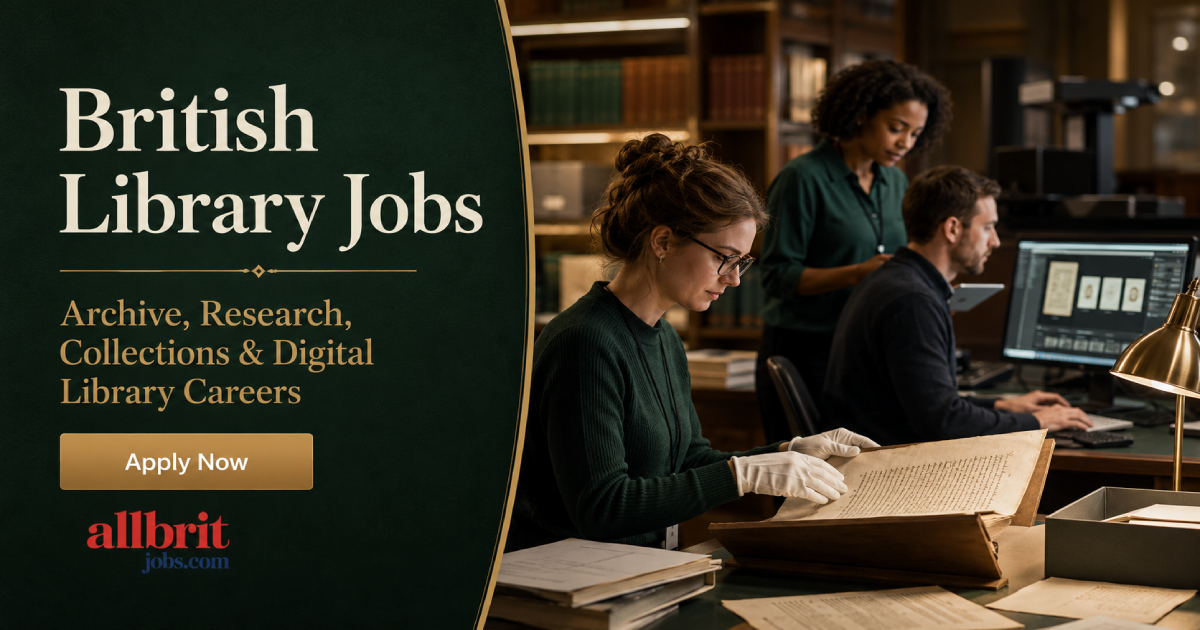
Establishing a professional pathway within British Library Jobs allows candidates to engage directly with world-class historical inventories. Pursuing British Library Careers provides access to dynamic opportunities across key locations, including specialized reading rooms in London, operational branches in Leeds, and collaborative frameworks in Cambridge. Vacancies within the national library and archive systems frequently seek skilled candidates for positions such as a Library Assistant, Archive Assistant, or Collections Officer. For those with technical expertise, a role as a Digital Curator enables the supervision of expanding digital collection services. These diverse research support roles ensure the preservation and accessibility of global cultural heritages for future academic research. Job seekers are encouraged to verify exact specifications from the official vacancy notice before starting an application.
British Library Jobs in Oxford, Cambridge, London, Newcastle upon Tyne, Leeds, Edinburgh, Sheffield and across UK
About The British Library
The British Library is the national library of the United Kingdom and stands as one of the largest research repositories in the world. Established as an independent public body by the British Library Act 1972, it is sponsored directly by the Department for Culture, Media and Sport (DCMS). Holding legal deposit status, the institution receives a copy of every work published in the UK and Ireland, maintaining an extensive catalog of over 170 million items including manuscripts, maps, stamps, and sound recordings. Operations are primary distributed between the main iconic site at St Pancras in London and the large-scale storage and digital processing facilities located at Boston Spa near Leeds. Governed by a dedicated statutory board, the library guarantees comprehensive support to academic, commercial, and creative communities, ensuring strict adherence to public transparency, regulatory compliance, and heritage conservation frameworks.
Available Positions
Library and Reader Services
- Library Assistant
- Reader Services Advisor
- Reading Room Assistant
- Customer Services Officer
Archives and Collections
- Archive Assistant
- Collections Officer
- Manuscripts Assistant
- Preservation Technician
- Conservation Assistant
Digital, Data and Research
- Digital Curator
- Metadata Officer
- Research Support Officer
- Digital Collections Analyst
Administration and Public Engagement
- Administrative Assistant
- Events Coordinator
- Learning Programme Assistant
- Communications Officer
- Project Support Officer
Salary and Benefits
Financial distributions within the institution adhere strictly to public sector pay scales and grading systems. The final salary depends on role, grade, location and official vacancy notice specifications. Appointed individuals have access to a secure Civil Service defined-benefit pension scheme alongside a competitive annual leave allowance starting at twenty-five days. Comprehensive workplace adjustments include flexible working patterns, compressed hours, and hybrid work options for eligible corporate departments. Continuous skill enhancement is prioritised through dedicated learning and development support initiatives.
| Job Category | Salary | Core Benefits |
|---|---|---|
| Library & Reader Services | £22,000 – £28,000 per year | Public pension scheme & season ticket loan |
| Archives & Collections | £25,000 – £36,000 per year | Flexible working arrangements |
| Digital, Data & Research | £26,000 – £43,000 per year | Generous holiday allowance |
| Administration & Engagement | £21,500 – £35,000 per year | Dedicated learning support tracks |
Eligibility Requirements
- Possession of a formal qualification in information management, archival studies, or an equivalent historical discipline.
- Practical administrative experience working inside an institutional cataloging system or visitor-facing archive environment.
- Highly developed communication skills necessary to assist academic researchers and international readers with complex source tracing.
- Proven organizational skills to manage delicate primary source manuscripts and operate secure digital scanning tracking systems safely.
- Clear teamwork ability to cooperate effectively with regional conservation and digital curation departments across distinct sites.
- Exceptional attention to detail combined with technical metadata knowledge required for accurate item classification.
Personal Experience
Embarking on a career within this national institution provides a profound connection to global intellectual history. Working in the reading rooms exposes personnel to complex academic inquiries, helping them refine their baseline research support capabilities. Employees regularly praise the collaborative workplace culture, where standard tasks involve processing rare medieval documents alongside cutting-edge electronic databases. Handling daily storage distributions builds precise operational discipline and an understanding of climate-controlled preservation metrics. The exposure to both physical and digital inventories ensures individuals develop a highly versatile skill set in information governance and data security. Furthermore, access to internal training pathways supports reliable career advancement, preparing professionals for long-term managerial and leadership roles across the wider heritage, civil service, and non-profit cultural sectors.
Common Mistakes Applicants Make
- Uploading an unadjusted, generic CV that fails to emphasize precision cataloging or research support experience.
- Submitting an incomplete application form with unexplained employment gaps or missing academic validations.
- Writing a supporting statement that does not address the specific civil service core competencies.
- Showing inadequate knowledge of the institution’s distinct legal deposit mandates and cultural obligations.
- Disregarding file formatting rules or word count restrictions during portal uploads.
- Miscalculating timeline requirements, which results in a missed deadline and automatic exclusion.
Pros and Cons
| Pros | Cons |
|---|---|
| Contributing directly to the preservation of national historical treasures.
Working inside a collaborative, intellectually stimulating workspace. Securing a robust public sector pension and flexible hybrid patterns. Expanding technical competencies in advanced digital collection systems. |
Facing rigid entry criteria and highly competitive multi-stage recruitment loops.
Managing intensive, repetitive database tasks during peak cataloging projects. Navigating strict public funding limits that impact rapid salary adjustments. Adhering to strict, unyielding physical security handling restrictions. |
How To Apply for British Library Jobs?
Candidates who want to pursue active British Library Jobs must complete their registrations through the centralized digital employment platform. To begin, job seekers should navigate to the official careers page to review live vacancies and verify specific station requirements across London or Leeds. You are required to create a dedicated user profile on the portal to access and fill out the official online application form. The system demands a comprehensive history alongside a tailored competency statement detailing your operational capabilities. After an initial administration screening, successful prospects progress to a structured interview panel designed to evaluate technical suitability. Ensure everything is finalised before the specified closing deadline.
| Source Name | Details |
|---|---|
| British Library Careers | Official careers, vacancies and benefits page. |
| British Library Official Website | Official national library website. |
| About British Library | Official organisation information page. |
| British Library LinkedIn | Official LinkedIn page for updates. |
Helpful Tips for Getting Hired Faster
- Tailor your application documents around clear information management and asset tracking accomplishments.
- Research the specific collection policies and recent digital transformation strategies of the institution.
- Practice situational interview answers focused on high-density information tracking and user support.
- Structure your personal statements around real examples of meticulous document security and data compliance.
- Check your entries via a comprehensive professional review to secure absolute accuracy before submitting.
Interview Questions
Question 1: As a Library Assistant, how would you assist a researcher who is struggling to locate a rare reference item that appears to be missing from the electronic catalog?
Answer: I would first verify the citation details with the reader to ensure no typographic error occurred during their search. Next, I would cross-reference our internal shelf-location databases and check recent reading room return logs or binding trackers. If the physical item remains unlocated, I would consult our collections management team while keeping the reader updated, ensuring a professional, transparent customer service experience.
Question 2: How do you prioritize asset safety and preservation protocols when managing a high volume of physical document requests from the public archives?
Answer: Preservation remains the paramount concern during any archival movement. I strictly follow standard document handling criteria, ensuring cradle supports and protective weights are utilized correctly. When volumes are high, I organize my retrieval patterns into structured batches to prevent rushed movements. By maintaining a methodical approach and checking item states before and after use, I safeguard fragile items from avoidable wear.
Question 3: What strategy do you implement as a Digital Curator to ensure long-term file integrity and metadata accuracy across massive digital collection services?
Answer: I embed automated verification checks, such as checksum validations, into our ingestion pipelines to monitor file corruption over time. For metadata accuracy, I adhere strictly to standardized schemas like Dublin Core or MARC21, running periodic schema audits. By combining automated script reviews with manual quality sampling, I ensure our digital assets remain searchable and stable for international research support roles.
Question 4: Imagine an unexpected technical failure shuts down the reading room reservation system on a busy morning. How do you handle reader entry as a Reader Services Advisor?
Answer: I immediately implement our offline contingency protocols to keep reader disruptions to a minimum. I switch to manual check-in logs at the reception desks to track user entry and exit securely. I explain the situation calmly and clearly to arriving visitors, ensuring they feel supported while our IT teams resolve the fault, thereby protecting the welcoming and orderly environment of our spaces.
Question 5: How do your organizational skills support the delivery of an international cultural exhibition involving rare loaned manuscripts as an Events Coordinator?
Answer: Success relies on meticulous timeline tracking and comprehensive risk management. I establish centralized project schedules that outline environmental criteria, courier arrivals, and courier security clearance deadlines step by step. By maintaining clear communication channels with international lenders, transport agencies, and internal conservation technicians, I ensure all compliance checkboxes are securely fulfilled well ahead of the public launch date.